Old Delhi Days
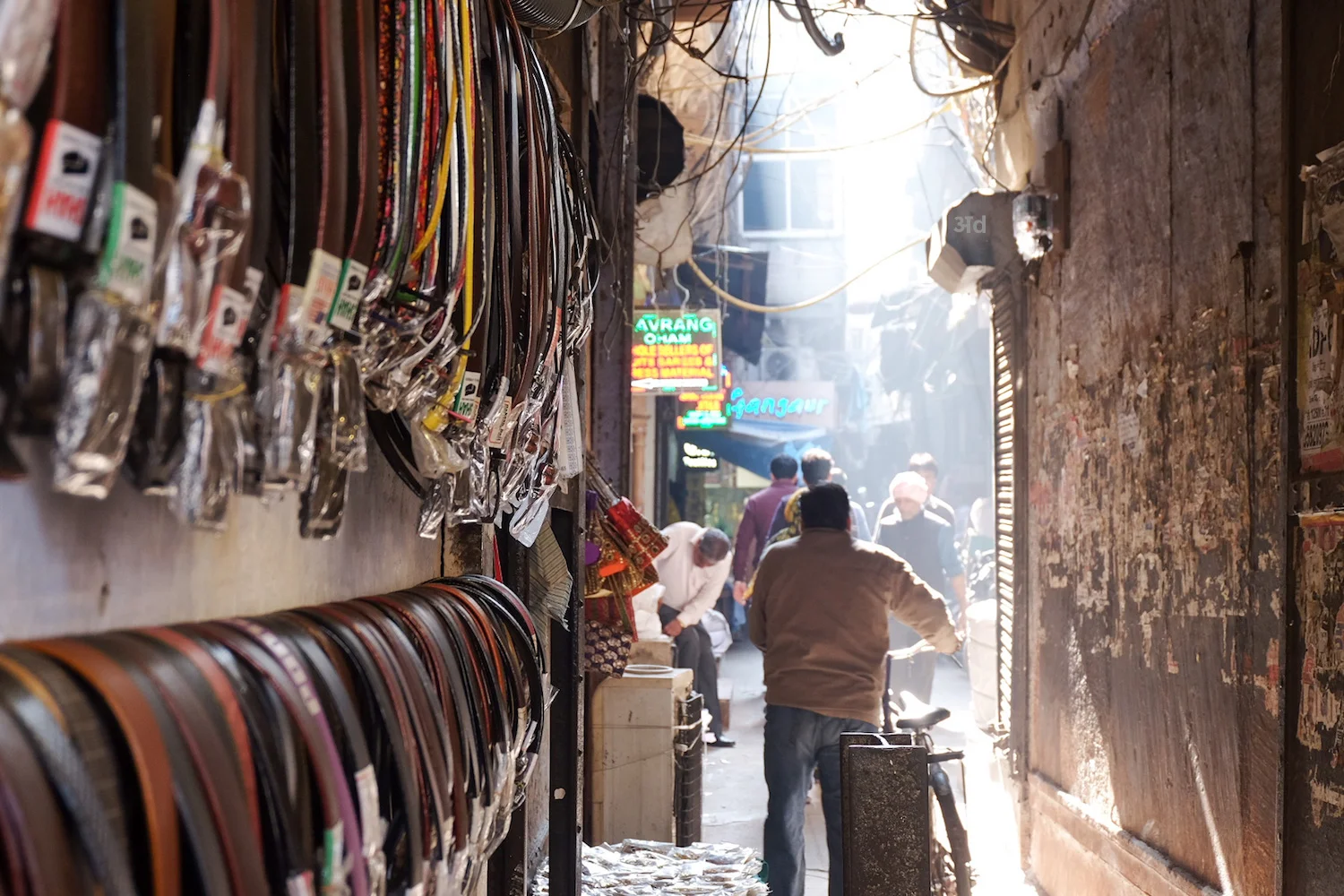
After my dad finalized his trip to India this past December, I decided I wanted to explore Old Delhi with him—partially because we had done this once before when I was in high school, and secondly because I liked the idea of sharing a nerdy, fieldwork day with him—the changing landscape of Old Delhi for him, the contemporary Delhi Metro (and our mode of transportation) for me.
After my dad finalized his trip to India this past December, I decided I wanted to explore Old Delhi with him—partially because we had done this once before when I was in high school, and secondly because I liked the idea of sharing a nerdy, fieldwork day with him—the changing landscape of Old Delhi for him, the contemporary Delhi Metro (and our mode of transportation) for me.
Though not originally from Delhi, my father has spent a lot of time in the city and knows it well. His dissertation explored urban images of Delhi through literature. He's also likely the reason behind the seeds of my own blooming Delhi interest.
Our adventure held a few objectives:
- Take the Delhi Metro to Old Delhi
- Document a few remaining katras that we could find
- Lots of pictures of the people, landscape, interesting happenings etc (per tradition) 1
- Eat
- Go to Karol Bagh for wedding shopping
So, we had a busy day ahead of us!
DELHI
Before diving into today’s Old Delhi, a quick history lesson:
Popular opinion states that there have been seven cities of ‘Delhi’. Essentially, these are the various dynasties that have claimed Delhi as their own, thus marking Delhi as a powerful region throughout the history of ‘India’ 2 . But the story starts even before these seven, dating all the way back to Indraprastha - the supposed home of the Pandav family from the Hindu epic The Mahabaharat, set between 400 BCE and 200 CE. There’s likely history even before Indraprastha, but details I am not aware of.
The seventh city of Delhi was known as Shahjahanabad3. This walled city of was built by Shah Jahan (same guy that built the Taj Mahal), of the Mughal Empire. Shahjahanabad served as the capital of the Mughal Empire from 1638 to 1857, after Shah Jahan shifted the capital from Agra, and until the Mughal Empire fell to the British. Today, the area of Shahjahanabad is known as Old Delhi, or, Purani Dilli, and encompasses almost everything I love (and hate) about Delhi.
Some notable attractions that Old Delhi holds:
Red Fort
Jamia Masjid
Chandni Chowk
Gurudwara Sis Ganj Sahib
Lal Mandir
The 14 gates that lead in and out of the city (I’m not sure how many of these are still standing, but I’ve seen at least 3, Turkman, Kashmiri, and Ajmeri)
So. Much. More.

Ah yes, some authentic Old Delhi street food, Mickey Ds, with Gurudwara Sis Ganj Sahib in the background.
KOOCHAS AND KATRAS
So, after grabbing the Violet Line from Nehru Place Metro Station, we got off at the Lal Quila (Red Fort) Metro Station.
It’s hard to describe just how amazing it is to be traveling in a fully air conditioned, clean Metro up to 80km/hr (50mi/hr) speeds, around 30m (98ft) underground, and then exit into the heart of Old Delhi, surrounded by roads and buildings that have existed since the 1600s.
Our marvel, however, was short-lived, as entering the heart of Old Delhi also means entering into a state of high-alert, while trying to navigate all of one’s senses.
We took a quick look at Red Fort on our left and then turned right onto Chandni Chowk in search of katras.

Beginnings of the Chandni Chowk hustle and bustle
What is a katra?4
"A katra is a cluster of houses and shops within a defined or undefined enclosed space. It is the smallest subset of a residential community. Most katras were actually massive havelis {mansions} earlier. Even the lanes and by-lanes within a katra were originally not lanes but navigable spaces, leading a person from one party of the haveli to another."
What is a koocha?5
"A koocha is generally a corner or a chauraha which serves as a common meeting place and leads to a katra. There can be several koochas in a katra. A koocha mostly has a lot of shops. Even today, most koochas are market places."


My dad was particularly interested in documenting some katras for his research. After stopping every so often to take photographs, my dad and I decided to enter a katra. He had been in them before, but apparently not as far as we went that day. As we went further and further, it became clearer and clearer that we did not belong there.
So, naturally, people (men) asked us along the way if we needed any help. My dad asked a few men the way back to Chandni Chowk and they pointed us down a very narrow lane. I could tell my dad was a little skeptical. To be honest, I was, too. Had I been alone...Actually, wait, I would never have done this by myself, so this point is moot.
Off we went, down this narrow lane filled with turns. I stopped for a bit to take some photographs, and a couple of the young men noticed we had stalled and came back toward us. This kind of freaked me out. But we told them I just wanted to snap a photo, and they went about their way.
A few minutes later, we found our way back onto bustling Chandni Chowk.

Looking above from inside the katra

Dad snapping some photos
CHANDNI CHOWK
We continued to walk through Chandni Chowk, toward Khari Baoli, an extension of Chandni Chowk known for spices and dried fruit.
We were called out by shop owners, mainly dried fruit sellers, to step in and make a purchase. My dad got lured by some raisins, and we ended up leaving with kishmish (raisins), badaam (almonds) and kaju (cashews). I was particularly fascinated by the variety of credit card companies the shop, that was established probably over a 100 years ago, now accepted.
As we we walked toward lunch, crossing the Fatehpuri Masjid (Fatehpuri Mosque), my father reminisced visiting his older brother at his workplace near the Masjid, and the time his family made a trip to Delhi in the 50s for his eldest sister’s wedding.
PARANTHE WALI GALI
Alas, the time had come for grub. We looped back onto Chandni Chowk and ducked into its infamous Paranthe Wali Gali.
The gali, once home to roughly 20 paranthe shops, now only has three. But, interestingly, all allegedly belong to branches of the same family. Still, the gali remains popular, and appears to be undergoing a revival, both in Chandni Chowk, as well as through various thematic restaurants that attempt to recreate the Old Delhi charm and parantha style.
The paranthe themselves are deep-fried and can come in many non-traditional varieties, such as badaam (almond), rabri (sweet, condensed-milk dish) or khoya (a type of dried milk typically used in sweets), but one can also get the classics. My dad and I opted to split a classic aloo (potato) parantha and wash it down with some of the best lassi (yogurt based drink) we’ve had.
Chandni Chowk scenes:


KAROL BAGH
The final task of the day was to head to Karol Bagh and shop for my dad’s formalwear to wear to my sister’s upcoming wedding.
We headed over to my father’s trusty kurta-pajama (kurta=long shirt, pajama= loose pants) shop, Raunaq. I’ve been hearing about this store for the last 20 years, ever since he first went there with my Maasadji (mother’s sister’s husband), to buy a new kurta-pajama for my cousin’s wedding that got scheduled while we were in India.
Since then, he’s been taken to this shop whenever he’s been in need of some new Indian formalwear. And not just by my Maasadji! A cousin on the other side of my family took him there once, and any time he’s sung the shop’s praises, but can’t remember its name, a local easily jumps in with the name.
I was skeptical though. To be honest, I was skeptical that it was still even in business, especially with the likes of Manyavar and other flashy Indian menswear brands. So, as my sister and I went to Karol Bagh the week prior for her own bridal trousseau shopping, we tried to scope it out. We found it, and it was PACKED. We realized pretty quickly that we were in the right place.
This time, the task to take my dad to Raunaq had fallen to me (as I like to pretend I'm a Delhi local these days). My dad and I grabbed an auto from Chandni Chowk and headed to Karol Bagh. We happily chatted along the way about some notable landmarks we passed. But once we arrived at Raunaq, our smiles quickly evaporated. Neither of us particularly enjoys shopping for clothes and the shop was, as always, packed. Ultimately, after some real-time Whatsapping with my mom, we made it out with some fresh kurta-pajamas and exchanged pleasantries with the owner of the shop. And I, once again, was reminded how much easier (and faster) it is to shop for men’s clothing.
We made a few more snack breaks along the way home, and ended our day by grabbing some tacos at Taco Bell. An appropriate parallel to our Paranthe Wali Gali adventure from the morning, I think, and a way to round out our research day by comparing Delhi's ever-changing landscape.

Looking incredibly American as we model our down jackets in an auto rickshaw selfie

Dad looking stylish during a chai break in Chaayos
My love of photography is actually a family tradition, with my father and grandfather also being avid photographers
India as a country is fairly young—attaining independence from the British Raj in 1947. However, the Indian subcontinent has had a strong presence for centuries and was arguably never meant to be a unified country
Click here for a nice overview on the walled city of Shahjahanabad
Either Total Irritation or Total Zen
Note: Initially drafted in November 2017 when I still lived in this neighborhood
Before I moved to San Francisco, I was confiding some of my pre-move jitters to a close friend in Los Angeles. In an attempt to console me, he told me about his theory that it takes about three months to adjust to any new place. I'm pretty sure I scoffed at the time, most likely thinking that three months is SO LONG, but as a surprise to no one, it actually isn't.
Note: Initially drafted in November 2017 when I still lived in this neighborhood
Before I moved to San Francisco, I was confiding some of my pre-move jitters to a close friend in Los Angeles. In an attempt to console me, he told me about his theory that it takes about three months to adjust to any new place. I'm pretty sure I scoffed at the time, most likely thinking that three months is SO LONG, but as a surprise to no one, it actually isn't.
And I ended up really, really liking San Francisco. (Some tears may or may not have been shed while packing up my SF apartment before leaving for India--not only because I was in a state of sleep deprivation).
I'm nearing my three month mark in Delhi/India, and of course it's flown by. I've certainly 'adjusted' in an adapted way, considering my role here is of a finite, extended visitor. But my new normal seems to be filled with me being in a state of either total irritation or total zen.
The spouts of irritation/zen don't last for days on end, or even an entire day. It's typically in short bursts of time, most commonly when I need to complete an errand.
Let's take a look at the nearly daily walk to my local market--about a 500m (.3 mile) walk:
Walk through Marg 9 (my street) and pass stray cats, dogs and the occasional family of monkeys. Pass the dhobi-wallah (man who irons the clothes for the neighborhood) to the left and a small park to the right.
Turn left and walk along the walls of an elementary school that borders the block. Walk through the gate and pass the guards (this gate is closed between 9:30p and 5a, so when needing to travel within this time, I have a slightly longer route).
Upon leaving the gate, walk past the Arya Samaj Mandir (temple), Jehovah's Witness Hall (that one surprised me, too), a Sai Baba Mandir (temple), a few phal-wallahs (fruit sellers) and phool-wallahs (flower sellers) for devotees to purchase offerings, an auto rickshaw stand, the infamous chipkali ATM, and a couple of ice cream thelas (carts). Where there's ice cream, there's Zen Ankita.
Irritated Ankita starts to make an appearance as I mentally prepare myself to cross the road to get to the market. Crossing the road in India deserves its own post, but in general, it's basically like a real-life version of Frogger. This intersection isn't even that bad, but I often need to be prepared for random U-turns while I'm standing in the middle of the road and deceitful motorcyclists that seem like they are slowing down and then speed up at the last minute.
Ankita's TIPS FOR CROSSING THE ROAD IN DELHI
Channel the way of Nike and 'just do it'
Go against Safety Town teachings. Sometimes it actually helps to not look both ways and feign ignorance (while hoping for the best)
Find a local and cross with them. Ensure the local, not you, is in the path of traffic (my preferred method)

Scenes from an incredibly empty market during Holi 2018

I have never seen the market so deserted and closed
5. Finally arrive at the market.
6. Stop at the newspaper-wallah and pick up a copy of the Times of India.
7. Pass by Safal - the fixed price veggie/fruit shop.
8. Pass the open-air hawker food court.
9. Walk past a plethora of fast food options (Dominos, Pizza Hut, KFC, Cafe Coffee Day, Burger King, and of course, McDonalds. I'm convinced my market has only 3-4 useful shops and the rest is just food).
10. Walk past 24 Seven (a well-stocked convenience store chain open 24/7 everyday, except Holi, apparently).
11. Walk past the bougie salon where I get my eyebrows threaded.
12. Walk a bit further to Mother Dairy (milk shop, ice cream shop, all things dairy).
Some common things I encounter while walking through the market:
Napping stray dogs
Folks trying lure me into their restaurants
Folks asking me to sign some sort of petition I know nothing about
Children seeing me with groceries and proceeding to follow me around, or pulling on my clothes while I'm in line to buy milk and eggs
Lots of bicycles for some reason? Including pedal cars for small children
Some days navigating through the market is one of those irritation moments and all I'm thinking is "I just need to buy some milk, get out of my way." Other days, and the longer I stay here, I become Zen Ankita and just blend into the background...Unless I'm crossing the road. Irritated Ankita nearly always makes an appearance then, mixed with Terrified Ankita. But then I just treat myself to some ice cream.

Deciding what sort of ice cream to treat myself to in order to reach Zen Ankita (circa March 2018). PC Jordan W
The Perception of Safety
For most of my time since arriving in Delhi, and even as I prepared for my trip, I've thought a lot about how to navigate feeling safe in Delhi and throughout India. I've thought about this through the lens of my identities as a woman, an American, an Indian-American, short-haired, iPhone user...the list goes on.
For most of my time since arriving in Delhi, and even as I prepared for my trip, I've thought a lot about how to navigate feeling safe in Delhi and throughout India. I've thought about this through the lens of my identities as a woman, an American, an Indian-American, short-haired, iPhone user...the list goes on.
I knew my perceptions of safety would be different than what I was used to in the States. I was prepared to generally feel unsafe. But I'm starting to wonder if that's not the case, or if it doesn't actually matter. I know this may seem confusing or hypocritical, especially since my research topic is women's safety and I lament about how different and gendered many of my experiences in India are.
In a way, I think I've become so vigilant about protecting myself, it's just become another one of my identities: someone with trust issues. Most of my fears have to do with assault, abduction, rape or theft. I'm not saying these fears, or even my constant awareness of these things, is something that people, men and women alike, should be concerned about (again, related to my research), but it has forced me to keep certain fail-safes in place. For example, auto rickshaws are my preferred mode of transportation--I can easily jump out, if needed. I avoid eye contact and smiling in public, avoid traveling alone at night etc. If I'm in a situation, where I feel uncomfortable, I shoot a message and my location to the 'Delhi Girls' Whatsapp group us Delhi-based female Fulbrighters created for this exact reason. I'm also indefinitely sharing my location on my phone with my sister in the US, and my parents and Fulbright always know of my travel plans outside of Delhi.
Yet, after waking up to news alerts about yet another mass shooting in the US, I can't help but reflect on which place is actually safer. I know, it's not that simple and there are statistics, economics and politics at play, along with individual perceptions of safety on a daily basis. But it does make me wonder if other foreigners visiting India share my thoughts when encountering the frisk/bag checks at Indian malls, movie theatres and metros systems: how possible is it still for someone to bring a firearm? Or is that just another 'American thing?'
San FranBangalore
I managed to get out of Delhi for a bit after a jam-packed few days celebrating my cousin brother’s wedding and spending the week prior in Mumbai. I was off to Bengaluru (Bangalore) for Carnegie India’s Global Technology Summit, followed by a few days by the beach in Goa. Life is hard, I know.
I managed to get out of Delhi for a bit after a jam-packed few days celebrating my cousin brother’s wedding and spending the week prior in Mumbai. I was off to Bengaluru (Bangalore) for Carnegie India’s Global Technology Summit, followed by a few days by the beach in Goa. Life is hard, I know.
I must admit, I hadn’t been looking forward to this trip. I think it was a combination of exhaustion from Mumbai and the chaos of a Punjabi wedding, but also because I don’t really care much for Bangalore. I came once before with my parents almost exactly 5 years ago. Though it was warm and very green, it was also incredibly congested and I remember spending much of the trip stuck in traffic. My roommate convinced me to attend the free conference, and it fit in well with my already existing Goa plans. It didn’t hurt that the conference was taking place at The Leela Palace Bengaluru. I also thought the trip could be a good opportunity to compare Bangalore and San Francisco’s tech scene, despite my love-hate relationship with the tech industry as a whole.
Long story short, it was pretty cool.
The conference was two full days of panel sessions on a pretty wide variety of topics, including strong undertones of Indo-Japanese relations, with Japan being the country sponsor of the conference--something I definitely plan to look into further. Highlights included an incredibly interesting talk by a VP of Olacabs (a Bangalore-based rideshare company, similar to Uber) on some research findings that led to their new product, OlaPlay, which essentially gives the passenger a tablet allowing them to control various aspects (temperature, music etc) of their ride from the comfort of the backseat. There was also an interesting session on the rise (and encouragement) of electic vehicles in India (apparently there is a goal to be ‘all-electric’ by 2030) and bicycle sharing.


Bengaluru ‘Namma’ Metro

Namma Metro train
Before the second day began, I checked out the Bengaluru Metro, also known as the Namma Metro, which opened six years ago. Phase I of the Namma Metro completed in June of this year, with two operational lines. After regularly riding the Delhi Metro and also exploring the Mumbai Metro for a few days, I didn’t expect to be surprised by the Namma Metro and was mainly curious to explore the boundary between the general and women-only compartments (this was an interesting differential point in Mumbai, more on that later). I also wanted to add another Metro card to my collection!
So, turns out there actually isn’t a women-only car in Bangalore...yet. It’s supposed to launch in December of this year, after they add more coaches. Currently there are only 3 coaches per train and surveys are being conducted to understand female ridership better and implement one or two women-only coaches based on ridership data. But based on my limited experiences in Bangalore thus far at this point and the fact the compartment doesn't yet exist, I wondered if a women-only compartment was even needed in Bangalore.
Security on the Namma Metro was also an interesting an unexpectedly pleasant experience. In both Delhi and Mumbai, both men and women have to deposit their bags in the X-Ray bag scanner and proceed to be pat-down while the bag is being scanned. I imagine this is done to save time, but is particularly annoying for women, as our pat-down is conducted in a closed-off booth with a curtain (for privacy? Modesty? Unclear). Though the booth does have a little slot out of which you can see your bag, I still get a bit nervous about my bag and belongingss when things are crowded. So, I normally carry my wallet and phone in my hand while my bag is scanned and I’m pat-down.
Now, Bangalore has got this system DOWN. First, you send your bag through the scanner, pick it up, and THEN proceed to the pat-down and only after security is complete do you purchase a ticket--not the case in both Delhi and Mumbai where security and ticket purchasing is all in the same general area.
Bangalore was, however, weird about me having a camera in my backpack and made me sign into a book claiming I had one. Interesting because there were no signs prohibiting photography, but Delhi Metro is very strict about ‘no photography’ signage, but I’ve never run into issues while carrying my camera (and even taking some photos in stations).
Being the tech city it is, Bangalore’s Metro stations had all sorts of interesting nuggets showcasing its newest and latest innovations (just like another city I know…) Some favorite finds were a grocery service, which is available in four Bengaluru Metro stations, and the presence of Ola share flat fare zone.



From a personal perspective, my general experience of riding the Namma Metro was a little uneasy. I think after Delhi, I’ve suddenly found myself reliant on the women-only coach in certain situations.
Knowing that I was going straight to the conference after my metro excursion and then straight to the train station after the conference, I packed up my duffle bag for my fellow Fulbrighter travel companions to bring to the conference and left the hotel/Airbnb wearing my conference clothes--a knee-length dress with tights and a sweater on top. I don’t typically wear dresses above my calf in India (definitely not in Delhi) but felt okay in Bangalore, perhaps because I’ve repeatedly been told South India is a bit safer than Delhi and because I imagined it would be a bit more western, given its tech presence. I was also in Mumbai less than two weeks ago and felt almost too conservatively dressed there, and I figured it wouldn't matter as much in the women-only coach, anyway.
Once I saw there wasn’t a women-only compartment, I immediately wished I had opted to wear jeans or leggings and a kurta. But I hadn’t. So off I went.
Now, I’m not sure if it’s because I was already feeling a little uncomfortable about my dress and tights, or because I’m very obviously North Indian, don’t speak Kannada (to be fair, I think the language diversity of Bangalore is continually and quickly evolving due to the migrant tech-force) or if it was actually the clothes, but I definitely felt more stares than compared to the Delhi Metro. This was unexpected and also made me wonder if maybe a women-only compartment actually is needed in Bangalore after all.
Ankita v. Chipkali
Growing up visiting India, I've developed several opinions on things I like and dislike about South Asia. Many of these thoughts on topics ranging from religious, cultural, political and otherwise, have evolved over time. However, one perspective that may never change is my dislike of the common house gecko, called chipkali in Hindi, or korkirli in Punjabi.
Growing up visiting India, I've developed several opinions on things I like and dislike about South Asia. Many of these thoughts on topics ranging from religious, cultural, political and otherwise, have evolved over time. However, one perspective that may never change is my dislike of the common house gecko, called chipkali in Hindi, or korkirli in Punjabi.
Though no more than 3-6 inches long and completely harmless, these creepy little guys, their quick crawls and tiny, curious eyes have always made me cringe. Especially when they are indoors.
I knew that I would encounter chipkalis during my year in a tropical climate. I also hoped that being in my mid-twenties would result in me being less of a scaredy-cat than my childhood India trips.
Things were going well. I braved an ATM one time that had about 5 chipkalis hanging out inside. I avoided eye contact, displayed no visible cringes, quickly withdrew my cash, and went about my day.
My roommate found one in her bathroom a few weeks later. I expressed my condolences and wished her the best of luck. About a week later she mentioned she was going to call our landlady to ask if her helper could come get rid of it. I admired her bravery for hosting the chipkali so long.
And then it was my turn.
A couple nights ago, being the night owl I am, I was working late in my room. I was just about to get ready to head to bed when I saw it. Out of the corner of my eye.
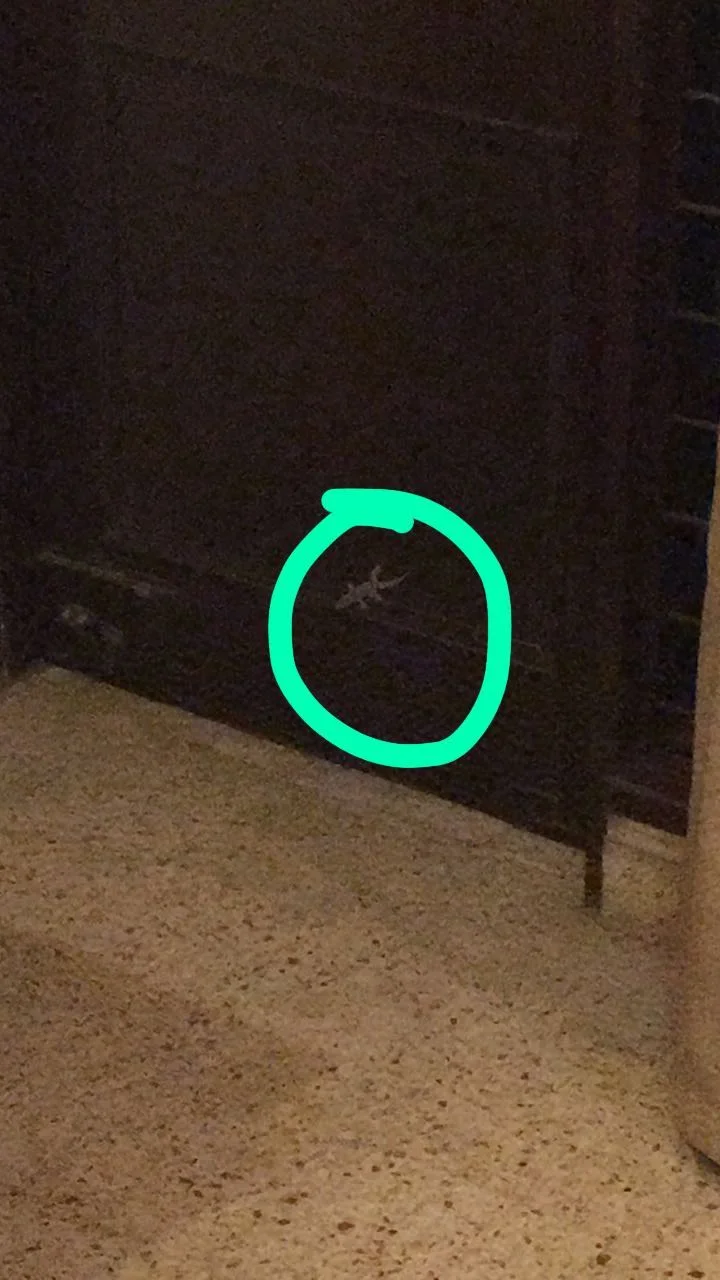
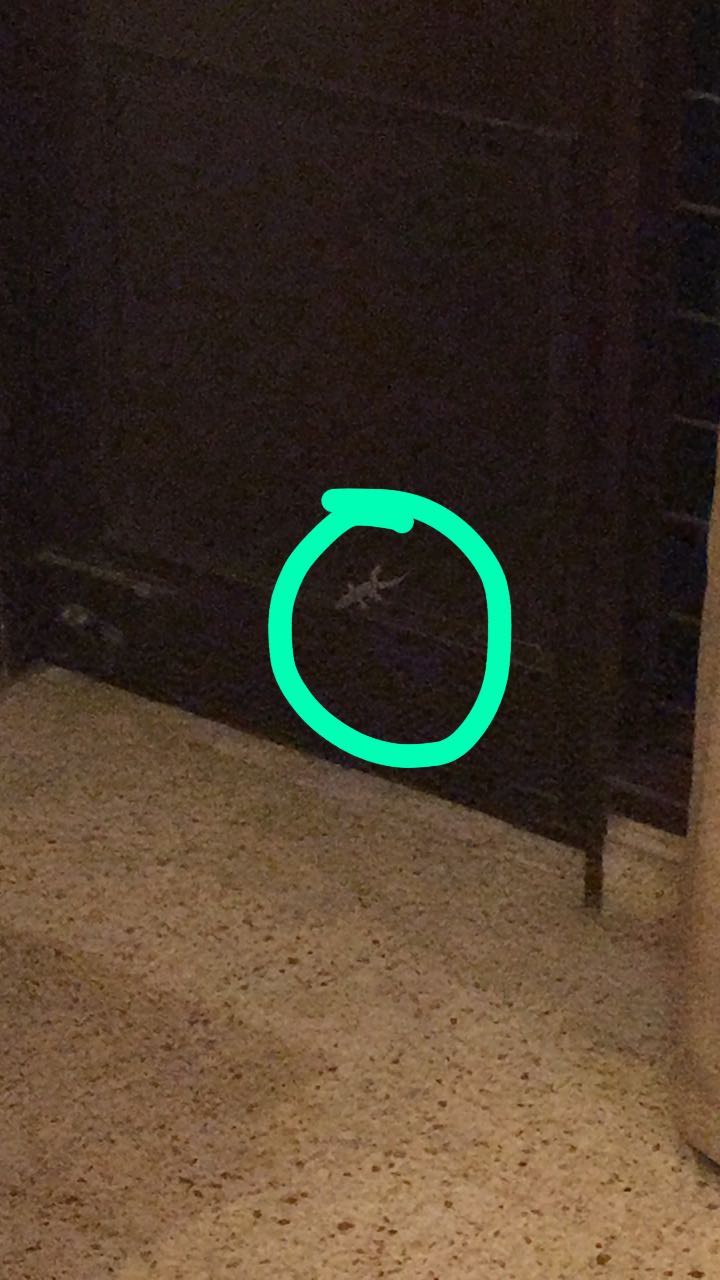
It quickly scattered across the door that leads out to my balcony. I let out a yelp, and ran to the furthest away corner on my bed and observed.
Thus began the two-hour battle of getting the chipkali out of my room. Shoutouts to my friend Ariel, spending her Fulbright in Udaipur, for keeping me company via my live and panicked WhatsApps, as well as my mother in Iowa for only minimally laughing at me when I called her in near tears. Twice.
The plan:
Unlock and open the door and wait for the chipkali to get out. Easy-peasy.
Reality:
Spend about 30 minutes trying to pump myself up to unlock the door. In the meantime, the chipkali has moved right next to the door handle.

The Plan 2.0:
Turn on balcony light and turn off all of the bedroom lights to encourage chipkali to head outside (it eventually moves right next to the top lock on the door).
Reality 2.0:
Unlock bottom lock and open window. Grab mop and broom from living room and 'gently encourage' chipkali to move so that I can reach the top lock.

The Plan/Reality 3.0:
Chipkali moves away from the top lock to the AC, nowhere near the now open door and window.
Engage in waving and banging of mop near the chipkali to try to guide it through the window. Dramatically scream and drop mop each time the chipkali moves.
After a certain point of too much adrenaline, exhaustion and illogical determination, I realized that I've successfully terrified both the chipkali and myself. I accepted my new reality and temporary roommate for the night.
I did some light reading while dousing myself in mosquito repellent (leaving the door and window open for about an hour brought a whole host of other unwanted friends) and learned that chipkalis are actually pretty cool--they prey on bugs and mosquitos. They are also repelled by garlic, so naturally I went to the kitchen and grabbed all the garlic I could find and brought it back to my room.
I took one last look at my chipkali, took off my glasses, and turned off the last remaining light.
